Bio
Training
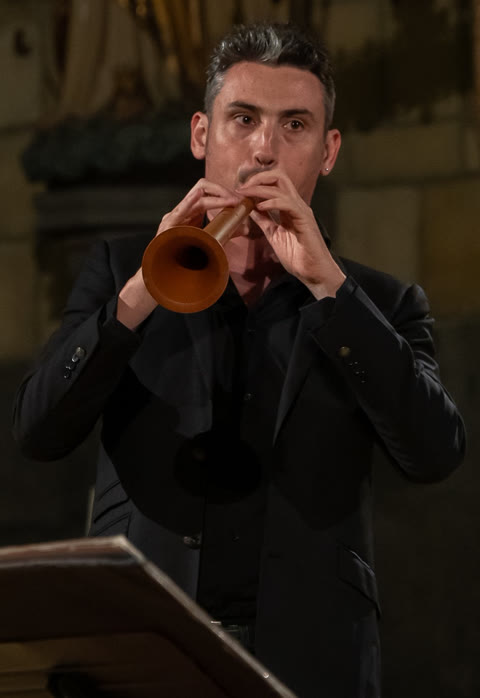
After studying the trumpet at the CRR (regional conservatoire) in Clermont-Ferrand (France), I discovered early music while training as an engineer, and taught myself the recorder and early oboes. I found little information on how to play them and no teacher in my region, but no matter: with a few enthusiasts, we would meet and try to work out how these strange instruments could possibly work…
In 2007, after a few years of amateur playing, I met Robin Joly in Vendée, on the courses run by the Compagnie Outre Mesure. It was a first revelation: I began to understand better the customs, playing techniques and repertoire of these instruments, which until then I had explored on intuition alone. There I also discovered the deep links between music and movement, and caught a bug that has never left me: dance. It became for me an art almost inseparable from music. Two years later, work took me to Paris, where Carine Moretton became my recorder teacher. With her, I happily deepened my playing and discovered how to read early notation.
In 2010, I felt a deep need to understand these instruments better and to give music a more central place in my life. I moved to Tours to enter the conservatoire, and studied there for almost ten years with three masters who would shape my path: Denis Raisin Dadre, recorder player and founder of the ensemble Doulce Mémoire, and Jérémie Papasergio and Elsa Frank, specialists in historical double-reed instruments. I completed my training with the full course in Art Ménétrier, a rich discipline devised by Robin Joly to explore the relationship between music and dance in the fifteenth and sixteenth centuries, combining treatises, musical analysis and choreographic reconstruction. My curiosity also led me to attend courses with other specialists in early double-reed instruments, including Michèle Vandenbroucque, Ian Harrison and Renate Hildebrand.
From 2016, I studied the baroque oboe with Elsa Frank in Caen, then with Jean-Marc Philippe in Orsay. I approached it as a continuation of the earlier oboes I know well, exploring what it preserves, transforms or renews in their construction and playing techniques.
On stage
I gained my first practical experience in Renaissance music with the Compagnie de l'Escarboucle (dir. Carine Moretton), the ensemble Le Banquet du Roy (dir. Olivier Gladhofer) and the Compagnie Outre Mesure (dir. Robin Joly), but also in medieval music (Cie JOER, dir. Xavier Terrasa) and in projects centred on early oboes (Les Hautbois d'Henry IV, dir. Hervé Barreau). I also joined several “street music” projects, where I met some of the constraints faced by my distant colleagues, the minstrels of the Middle Ages and the Renaissance. Such conditions spurred my practical research into instruments, reeds and playing, in order to combine endurance, efficiency and musical eloquence as well as possible.
In 2015, I joined the ensemble Doulce Mémoire for the show Magnificences à la cour de François Ier, performed some thirty times around the world, in which I combined Renaissance recorders, shawms and dulcians with historical dance. I then took part in many projects and recordings with Syntagma Amici (dir. Jérémie Papasergio), InAlto (dir. Lambert Colson), the Sollazzo Ensemble (dir. Anna Danilevskaia), Diabolus in Musica (dir. Nicolas Sansarlat), La Grande Chapelle (dir. Albert Recasens) and Capella Sanctae Crucis (dir. Tiago Simas Freire). I also greatly enjoy exploring the baroque repertoire with Le Poème Harmonique (dir. Vincent Dumestre), the Ensemble Correspondances (dir. Sébastien Daucé), Le Concert Spirituel (dir. Hervé Niquet) and Le Caravansérail (dir. Bertrand Cuiller).
I also share my passion for dance by leading many balls, workshops and masterclasses on the Renaissance musical and choreographic repertoire.
Into the Winds
In 2017, I co-founded the ensemble Into the Winds (opens in a new tab) with Anabelle Guibeaud, and I am now its artistic director. Devoted to the secular and sacred repertoires of the late Middle Ages and the early Renaissance, the ensemble seeks to bring them to the widest possible audience through original concerts on wind instruments.
Winners of the International Van Wassenaer Competition at the Utrecht Early Music Festival in 2019, we have since performed at many festivals across Europe: Ambronay, Saintes, Flâneries musicales de Reims, MA Festival, La Cité Bleue, Innsbrucker Abendmusik… Our two albums, released on Ricercar, have been acclaimed by the critics (see the recordings).
Today I seek to bring together research, teaching and concert production around early music, blending academic knowledge with contemporary creativity. In this way I hope to reveal little-known areas of repertoires whose originality and vitality the wider public too often overlooks!