Adrien Reboisson — early recorders and historical double-reed instruments
The term “early music” has always struck me as a misnomer. Remarkably vague, it gathers countless periods, tastes and composers under a generic, almost pejorative banner. It suggests that styles were entirely compartmentalised, whereas the history of music is nothing but a continuity of aesthetics slowly matured by each generation. It wraps everything in a veil of anecdotal exoticism, conveying the idea that before the so-called “classical” period there was no Brahms, Wagner, Gershwin, Glass or even Michael Jackson — that is to say, no geniuses at the height of their art, transcending the spirit of their time. We must therefore begin by casting off this post-modern reading, so as not to see here merely some vague folklore with reactionary leanings.
This music is the soundtrack of a time that is decidedly no longer ours. As such, it is an invitation to an inner journey that questions our relationship with today's world, its values and its sense of the transcendent. Counterbalancing the perpetual, frantic forward rush of modern man, it opens, for a brief moment, a door behind which lie hidden the most heavenly ecstasies of religious fervour, of chivalrous enthusiasm... It plunges us into new and unfamiliar aesthetics, at times noble and grave, at times joyful and light, always full of vitality. The perfect measure and harmony of fifteenth-century Franco-Flemish music, the gentle harshness of the Italian frottole of the quattrocento, like a chiaroscuro by Caravaggio, the firm and serene faith that emanates from the sacred music of Eustache du Caurroy, the virtuosity of Dalla Casa's diminutions, whose performance was meant to imitate the sound of the wind in the leaves of the trees, or again the simple, rustic joy of popular dance music... It is a continent to explore, the witness of an era rich in discoveries and upheavals, which shaped Europe and whose children we are. A continent which, with its many mysterious and unexplored territories, keeps our imagination awake — something essential, in my view, in our modern world, which Bernanos called “a universal conspiracy against every kind of inner life”.
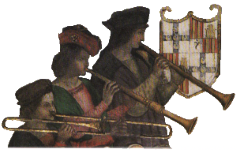
Take an oboe in your hands, put the reed to your lips: even before playing a note, we find ourselves in the very posture of dozens of generations of minstrels — musicians in the service of power — depicted in countless paintings and frescoes from the twelfth to the eighteenth century. The journey begins here, in the study of this abundant iconography of feasts, processions, religious ceremonies and allegories uniting the haut (loud) and bas (soft) instruments: silent images bearing witness to events whose soundscape it is fascinating to try to recreate. Often played in “bands” (in groups), sometimes together with brass, shawms (the early oboes) offer a full, straight sound and a rich timbre, not yet adapted to the constraints of the modern orchestra. At times serving a simple, popular style of writing, at times a subtle counterpoint built like a cathedral of sound, they deliver a wide spectrum of energies and styles. At the very heart of the sound, the ceaseless succession of full, pure harmonies pervades mind and body, sometimes in an almost hypnotic way. As a musician, forging this sonic material, seeking the full harmony of the chords and the complete resonance of the instruments to bring back the images of a vanished world, is a quest as fascinating as it is elusive.